

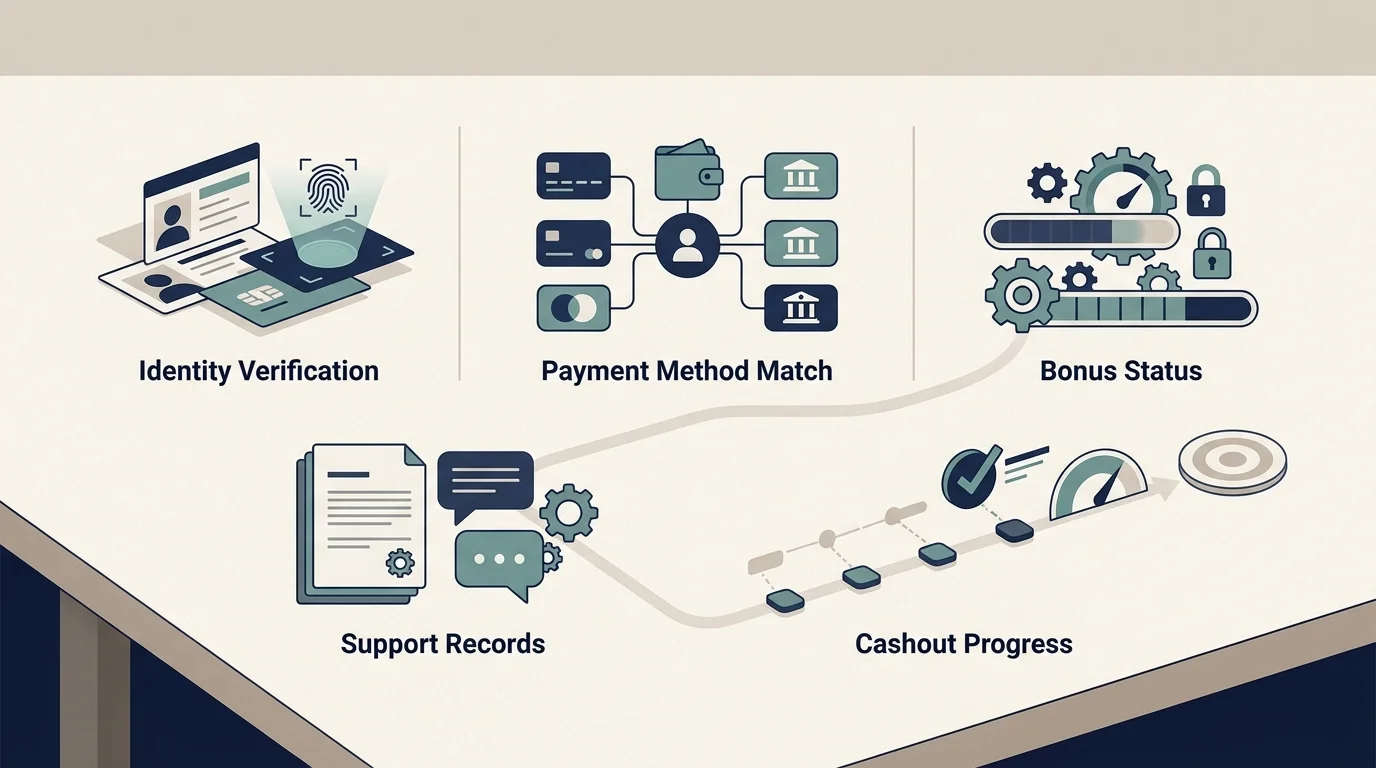
SlotMonster withdrawal evidence covers the same method categories as deposits — cards, bank transfer, Apple Pay, MiFinity and cryptocurrency — but the cashout journey is governed by a different layer of rules. Verification can be required before withdrawal, real-money and bonus-derived balances are treated separately, and the deposit method usually has to match the withdrawal method up to the funded amount. Exact withdrawal limits, processing fees and clearance times are not stated as current SlotMonster terms here; the operator’s published cashier values are the only authoritative source. Public reputation signals — a very low Casino Guru Safety Index and a mixed Trustpilot record — point to withdrawals as one of the friction-heavy parts of the SlotMonster experience, which makes preparation before the cashout request more valuable than a fixed timing estimate after it.
The withdrawal facts that can be stated
A small set of withdrawal facts about SlotMonster sits firmly inside the public record. Payment evidence includes cards, bank transfer, Apple Pay, MiFinity and cryptocurrency methods, and that same set of categories is generally available for withdrawals, subject to each route’s specific support in the cashier. The reviewed currency lists did not show GBP, so a UK reader cannot assume sterling withdrawals are configured by default. Verification can be required before withdrawal, which is the standard non-UKGC pattern; live chat and email-support routes are both listed as channels for account-level questions through the cashout process.
Several specifics are not in the safe-to-state set: exact daily and weekly withdrawal limits by method, exact fees for each method, exact clearance times from request to receipt, and the precise document list KYC will request at withdrawal. Independent review snippets sometimes quote figures for these, but they are usually paraphrasing the marketing layer rather than the live terms text. The cashier and the current terms page are the authoritative sources.
For the deposit side of the same journey, the SlotMonster payments page covers method categories, currency questions and the UK credit-card position. For the account-level prerequisites — registration, identity documents, payment-method ownership — the SlotMonster account page handles the sequence that ends in a verified, withdrawal-ready account.
Withdrawal readiness checklist
Most SlotMonster withdrawal friction comes from work that should have happened earlier. The checklist below covers the preparation that makes a cashout request more likely to clear without intervention.
- Verify the account before making the first withdrawal request, not after. Document upload after a balance is built is the slowest path.
- Confirm that the payment account is in your own name and matches the casino account exactly — first name, surname, country of residence, date of birth.
- Match the deposit method to the planned withdrawal method, at least up to the funded amount. Some operators send the funded portion back along the deposit route and the remainder by a fallback method.
- Check the bonus state before requesting a withdrawal. An active bonus with unfinished wagering can lock part of the balance.
- Save the cashier screen at the moment of the withdrawal request: method, currency, amount, bonus state and any reference number that appears.
- Note the expected processing window from the operator’s terms, not from a review article. If a window is published in the cashier, save that text as well.
- Use the email-support route in parallel with live chat if the request involves a non-routine question (large amount, source-of-funds query, document re-request). Email creates a written trail that live chat sometimes does not.
None of these steps shortens a cashout that is already in progress. They reduce the probability of friction before the request is filed.
Why withdrawal times need verification at the moment of cashout
Withdrawal-time headlines like “24 hours” or “instant” are common on operator marketing pages and rarely match the contract. A typical processing path has at least three stages: the operator’s internal review, the chosen processor’s clearance window and the receiving bank or wallet’s posting time. Each stage has its own timing. A “24-hour” headline often refers only to the first stage; the round trip to the player’s account can take longer if a card processor or bank adds days at the back end.
For SlotMonster specifically, no fixed processing time is stated on this page because the public record does not contain a verified UK-facing figure. The operator’s own withdrawal-policy text and the cashier screen at the moment of request are the authoritative sources. A UK reader benefits from reading both: the policy gives the official window, the cashier gives any temporary status note that the policy text does not always reflect (high-volume periods, method-specific delays, scheduled maintenance).
The cleanest expectation-setting habit is to take the longest stated time in the policy text, add a buffer for the processor leg, and plan around that figure rather than around the headline. If the actual clearance is faster, the surprise is a positive one; if it is slower, it sits inside the planned window.
KYC and account details before withdrawal
The non-UKGC standard is that identity verification can be requested at any point before a withdrawal is released. SlotMonster’s recorded position aligns with that standard. The exact KYC document list is not stated as a public fact here, but the usual non-UKGC request set includes a government-issued photo ID (passport, driving licence or national ID), a recent utility bill or bank statement showing the registered address, and proof of payment-method ownership for the funding instrument. Source-of-funds questions can also be raised for larger amounts.
The friction-reducing preparation is to gather these documents before the first withdrawal request, photograph them clearly under good light, and confirm that every detail on the casino account matches every detail on the documents. Common mismatches that delay withdrawals include a maiden name on one document and a married name on another, an old address on a utility bill, a card image where the middle digits are masked but the masking covers the digits the operator wants to see, and selfies taken at angles that obscure the document border. Each of these is a fixable issue; each one adds days when it triggers a re-request.
For the underlying account journey, the SlotMonster account page covers registration, KYC sequence and the official-URL safety checks that prevent identity documents from being uploaded to a lookalike domain.
Bonus rules can become withdrawal rules
A casino bonus does not stop being a contract at the moment a player decides to withdraw. If an active bonus has unfinished wagering, the standard non-UKGC approach is to apply the bonus terms to the withdrawal request: real-money and bonus-derived balances are separated, unfinished wagering may forfeit the bonus-derived portion, and the maximum-bet rule during the wagering period can void winnings if it has been breached at any point in the session.
For SlotMonster specifically, the safest withdrawal path is one of two: either wager out the bonus fully before requesting a withdrawal, or cancel the bonus through the cashier or support before depositing more, accept the loss of the bonus, and withdraw only the real-money portion. Mixing the two — requesting a withdrawal while a partly wagered bonus is still active — is the path that produces the highest rate of disputes in the public reputation pattern.
The SlotMonster bonus page covers the bonus contract layer in detail, including the ten-point checklist for reading any current offer. The cashout-side message is simpler: read the bonus state before the withdrawal request, and treat any active bonus with unfinished wagering as a reason to pause and decide before clicking through.
What patterns in withdrawal complaints actually mean
Public reputation signals around SlotMonster point at withdrawals as the friction-heavy part of the journey. Reading those signals well means looking at the underlying detail rather than the headline tone. A pattern across multiple recent Trustpilot reviews mentioning “delayed payout” can describe at least three different situations: a player who has not completed KYC, a player whose payment-method ownership has not been verified, or a genuine processing delay on the operator side. The same surface tone hides different mechanics, and the right response differs by mechanic.
Specific markers in a complaint give better information than the star rating. Mentions of repeated KYC re-requests usually indicate either weak document handling by the reviewer or strict source-of-funds review by the operator; either way, preparation before deposit reduces friction. Mentions of bonus voids on withdrawal usually indicate that a maximum-bet rule or game-weighting rule was breached during wagering; the prevention is reading the contract before claim. Mentions of “I never got my money” without specifics are weaker as evidence than mentions that name a method, a date and a stated reason from support.
The SlotMonster reviews and complaints page covers the five-attribute filter for reading any review source — source, date, issue type, evidence and response pattern — and applies it to Casino Guru and Trustpilot in particular.
Escalation record for a stalled cashout
A withdrawal that has stalled past the stated processing window benefits from a calm, written record rather than an angry chat session. The records to assemble are the same in every case: the date of the withdrawal request, the method chosen, the amount, the bonus state at the moment of request, any verification request that has been issued by the operator, the player’s response to that request and the dates of every support exchange. The same records also support a complaint to a reputation site if it comes to that.
Escalation routes on a non-UKGC operator are narrower than on a UKGC-licensed one. The operator’s own internal complaints process is the first channel. Casino Guru and AskGamblers run public complaint mediation; both produce useful pressure but offer no binding decision. UKGC alternative dispute resolution does not apply because SlotMonster is not in the UKGC register. The SlotMonster licence page covers the licence position that shapes which routes exist; the practical takeaway here is to keep escalation written and dated, because that material is what every available route will ask for.
For the underlying decision about whether to use a non-UKGC operator at all when withdrawal protection matters, the licence comparison on the main SlotMonster UK review sits in the right place.
Final cashout decision path
- Verify the account fully before the first withdrawal attempt.
- Check the bonus state and decide whether to wager out, cancel or accept a partial withdrawal.
- Choose a withdrawal method that matches the deposit route up to the funded amount.
- Read the operator’s stated processing window and plan around the longest figure plus a buffer.
- Save the cashier screen, the reference number and the time of the request.
- Respond to any verification request quickly and with clean documents.
- If the window passes without funds, send a single, dated written enquiry through support and save the reply.
- If a second window passes, escalate through the operator’s complaints process, then to public mediation routes if needed.
SlotMonster withdrawals FAQ
How long do SlotMonster withdrawals take?
Can I withdraw without identity verification?
Does crypto speed up withdrawals?
What happens if I withdraw while a bonus is active?
What if a withdrawal stalls past the stated window?
Material created by the team SlotMonster