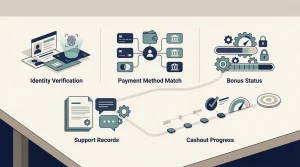


A casino’s base and its permission to serve Great Britain are separate; overseas approval does not replace the relevant UKGC licence.
What “Without a UK Licence” Means for Players
A casino’s location and its permission to serve customers in Great Britain are separate questions. A company may be based outside the UK and still hold a UK Gambling Commission licence for the gambling services it offers to British customers. Conversely, a site may be accessible from Britain while having no such licence. The phrase “without a UK licence” describes the operator’s regulatory status in this market, not simply the country where its offices or servers are located.
For operators, the key issue is where the gambling service is being supplied. A business serving customers in Great Britain needs the relevant licence from the UK Gambling Commission, even if it is established overseas. Being licensed by another country does not, by itself, replace that requirement. Nor does an operator become authorised in Britain simply because its website opens here or accepts a registration from a British address.
That distinction can be easy to miss. A non-UK-based casino is not automatically unlicensed in the UK: it could hold a UKGC licence. Equally, a foreign licence alone does not establish that a casino may lawfully offer its service to people in Great Britain. When you assess a site, look at whether the operator holds a current UK Gambling Commission licence for the relevant activity, rather than relying on its branding, location or a general claim that it is “licensed”.
The rules focus on the business providing the service. The Gambling Act 2005 sets obligations for operators that make gambling available to the UK market; it does not treat an individual player as the party committing the licensing breach. British citizens are not explicitly barred by UK law from using gambling services licensed in other countries, and playing on a site that lacks a UK licence is not, in itself, a criminal offence for the player.
That point is about criminal liability, not an endorsement or a guarantee of safety. It does not turn a non-UK-licensed casino into a lawful UK operator, and it does not mean that every service accessible to you is suitable or dependable. The operator’s duty to hold the required permission remains distinct from the player’s position under the law. If a site is taking customers in Great Britain without the necessary UKGC licence, the licensing issue concerns the operator.
Casino Sites: UK Deposits, Licensing and Access
There is also an important geographical qualification. The Gambling Act 2005 applies in England, Wales and Scotland, but not Northern Ireland. The UK Gambling Commission’s licensing requirement described here concerns services supplied to customers in Great Britain. Do not assume that this summary settles the rules that may apply in Northern Ireland or in another country where you live or travel; local requirements can differ.
Searches for an online casino without a UK licence often combine several different situations. One site may be based abroad but licensed by the UKGC. Another may hold a foreign licence but lack UKGC authorisation. A third may have no relevant licence at all. Those differences matter: “foreign casino” is a description of location, while “without a UK licence” is a description of UK regulatory status. They should not be used as if they mean the same thing.
A claim that a site is the best casino without a UK licence does not answer the legal question. Rankings and promotional language cannot establish whether the operator is authorised to serve Great Britain. The same is true of a “new casino” label: being newly launched says nothing by itself about permission to operate here. First establish what the site is claiming about its licence and which company is actually providing the gambling service. Do not read access to a site as proof that it has been approved for the British market.
If you are considering a casino without a UK Gambling Commission licence, keep the legal distinction clear. You are not committing a criminal offence merely by gambling there under the UK position described above, but the operator may still be supplying a service into Great Britain without the required authorisation. A licence from elsewhere does not erase that difference. Check the operator’s status and consider the implications before you deposit; the absence of player criminal liability should not be mistaken for protection from every practical or financial problem that could arise.
Playing at a casino without a UK licence does not make you a criminal, but it means the operator is providing services in Great Britain without the required authorisation.
Recommended online casinos
- x3betBonus: Welcome Pack 100% Up to £1.000 + 200 Free Spins · Payout speed: 1-3 business days
- NightWinBonus: £900 + 400 free spins · Payout speed: 1-3 business days
- WinBeastBonus: €5000 + 500 FS + €650 Freebet · Payout speed: 1-3 business days
- DieselwinBonus: Welcome Pack 250% up to £4000 + 200 FS · Payout speed: 1-3 business days
- ChanzeBonus: Slots Welcome Bonus #1 200% up to €500 · Payout speed: 1-3 business days
- Revery PlayBonus: 100% up to€1,000+ 100 FS · Payout speed: 1-3 business days
How Non-GamStop Sites Differ from UK-licensed Casinos
A casino outside GamStop is not connected to the UK’s national online gambling self-exclusion scheme. The practical difference is important: registering with GamStop does not prevent you from opening or using an account at a site that is not part of the scheme. A block that applies across participating UK-licensed operators does not carry over to every gambling website you can reach.
That does not make a non-GamStop site an extension of GamStop, or a way to manage a self-exclusion safely. If you have excluded yourself because gambling is causing harm, access to other sites may remain possible, and the protections attached to your exclusion may not follow you there. The name describes the site’s relationship with one scheme; it does not tell you whether the operator offers other controls, how well they work, or whether it will honour a request to stop gambling.
The practical difference in safeguards
UK-licensed casinos must provide responsible-gambling measures within the UK regulatory framework. At a non-UK-regulated casino, comparable protections may be less comprehensive or may not be mandatory. You may not have access to the required tools and oversight you would expect at a UKGC-licensed operator, including safeguards such as deposit limits and self-exclusion schemes. Do not assume that a control shown on a website works in the same way as a regulated UK tool.
Some sites may display options for setting limits or closing an account. Their presence alone does not establish how quickly a request takes effect, whether it applies across related brands, or what happens if you later ask to reopen an account. Check the terms and the operator’s process before depositing, but treat any voluntary feature as different from a protection backed by UKGC requirements.
Online Casino With No Sister Sites in the UK
This matters most when you are trying to limit or stop your gambling. If a site is outside GamStop, your existing exclusion will not block it. Creating an account there could undermine the boundary you set with participating operators, even if the site presents its own safer-gambling controls. If you are struggling to keep gambling within limits, stepping away and seeking support is safer than relying on a site’s optional settings.
Data and account controls
Rules around handling personal information and responsible gambling can also differ. Non-UK-regulated operators may be subject to less demanding standards in these areas than casinos overseen by the UK Gambling Commission. That does not mean every such operator handles data badly, but you should not assume UK-level requirements apply simply because the site accepts customers in Britain or uses familiar gambling features.
Before sharing identity or payment information, read the privacy notice and account terms. Look for an explanation of what information is collected, why it is used, and how to contact the operator about your account. Pay attention to the steps for setting limits, taking a break, or closing the account. If those details are unclear, that uncertainty is itself relevant when deciding whether to register.
An online casino not on GamStop may look similar to a UK-licensed casino: it can offer familiar games, account pages and customer support. Appearance is not a reliable guide to the protections behind those features. Nor does a label such as “MGA casino” or “Curaçao casino” mean that GamStop applies. A site’s regulator and its participation in the UK self-exclusion scheme are separate matters.
Do
- Check the operator’s specific process for setting limits
- Read the privacy notice before sharing identity information
- Treat voluntary controls as separate from UKGC requirements
Don’t
- Assume non-GamStop sites are an extension of the scheme
- Rely on a site’s appearance as a guide to its protections
- Mistake a foreign licence for a UKGC authorisation
What you may not be able to rely on
Playing outside the UKGC system also means losing access to protections tied specifically to UK-regulated gambling. For example, the Financial Ombudsman Service is not a route available to resolve a dispute with an offshore gambling operator. You should not assume that a UK regulator or UK complaint service can intervene if a site handles a limit request, account closure, or personal information differently from what you expected.
That is a practical distinction, not a reason to panic. It does mean you need to assess the operator’s own terms and controls before relying on them. If you have used GamStop to create distance from gambling, a casino outside the scheme will not preserve that distance for you. It may be accessible, but access is not the same as protection.
New Offshore Casinos: What Their Claims Do—and Don’t—Tell You
A newly launched casino can look appealing: its site may feel fresh, its promotions may be prominent, and its name may be presented as a new option for UK players. But being new tells you only that the brand or service has recently appeared. It does not show that the operator is reliable, that its terms are suitable for you, or that it is authorised to serve customers in Great Britain.
The same caution applies to Casinos not on GamStop. A new site’s wording may suggest that it is designed for UK players, but marketing language is not proof of its status or the protections it provides. Nor does a launch announcement establish how the operator handles verification, account restrictions or customer complaints. Treat claims about being “new”, “trusted” or “made for UK players” as statements to examine, not as independent evidence.
What a launch claim can establish
A launch date can help distinguish a recently introduced brand from a long-running one. It cannot provide a meaningful track record of how that operator behaves when a customer asks to withdraw winnings, challenges a decision or needs support. With a new service, there may simply be less public experience to assess. That is not proof of misconduct, but it is a reason not to mistake novelty for reassurance.
Online Casino No Registration UK: What It Means
Be precise about what the operator is claiming. A modern-looking website, a large game catalogue or an advertised payment method says something about the service being presented; none of those features, on its own, demonstrates that the operator is suitable for someone in the UK. Read the terms that apply to your account rather than relying on summaries or promotional wording. Check whether the site clearly identifies the operating company and explains the conditions attached to its services.
Claims about player numbers, popularity or rapid growth can also be difficult to evaluate from an advertisement alone. Without a clear basis for the claim, it should not carry much weight in your decision. A polished presentation is not the same as evidence about how a company handles customers.
Payment options are not guarantees
Non-UK-regulated casinos may offer credit-card payments, e-wallets, bank transfers or cryptocurrency, sometimes using payment processors other than those familiar from UK-licensed sites. The options can vary by operator and may change. Their presence is a description of how a site may accept deposits, not a recommendation to use it.
A deposit method does not establish that a withdrawal will be available through the same route. The operator’s terms and payment arrangements matter, and a payment logo on a page does not explain what will happen if a transaction is delayed or an account is reviewed. Check the actual conditions before sending money, and do not assume that a newly introduced payment option makes the operator more dependable.
A specialist review has also reported cases where a deposit could be charged to a mobile phone bill or taken from a prepaid balance. Treat that as a report of a possible arrangement, not as a standard feature of new casinos. Availability can depend on the operator and may change.
Keep the decision separate from the sales pitch
If you are considering a new offshore casino, pause before acting on a launch offer or a claim that it is built for UK players. Ask what the statement actually confirms, and what it leaves unanswered. A new brand may be worth investigating, but novelty does not replace checking the company, its terms and its position in relation to customers in Great Britain.
Online casino payouts in the UK: RTP and returns
There is no need to treat every new operator as automatically unsafe. Equally, there is no sound basis for treating a recent launch as a sign of quality. If the information is unclear, or the site’s claims cannot be checked, you can decide not to deposit rather than relying on assurances that the operator itself has published.
A Swedish Licence Is Not the Same as Permission to Serve Great Britain
A casino described as operating without a Swedish licence is not automatically authorised to accept customers in Great Britain. The wording tells you only that the operator is being discussed in relation to a Swedish licence; it does not establish whether the operator holds the permission required for the British market. Those are separate questions, and the first cannot answer the second.
For customers in Great Britain, the relevant issue is whether the operator holds a licence from the UK Gambling Commission for the gambling services it provides. That requirement applies regardless of where the business is based. An operator does not avoid it by being located abroad, using a different licence, or describing its service as international.
This distinction matters when a site uses broad descriptions such as “licensed casino” or names a regulator in its footer. A licence may be genuine and still not be the authorisation needed to serve Great Britain. The location of the regulator, the licence’s scope and the markets it permits are not interchangeable. A country name in a casino’s advertising is not enough to establish that the site can lawfully serve British customers.
The same point applies to the phrase “casino without a UK licence”. It describes the absence of a UK Gambling Commission licence, but it does not tell you which other licences the operator may hold or what those licences allow. Nor does the phrase “without Swedish licence” mean the operator has a UKGC licence. The British requirement stands on its own, independently of how a site’s position is described in relation to Sweden or any other country.
Anjouan Licence
An Anjouan casino licence does not authorise an operator to serve the United Kingdom and explicitly excludes restricted markets.
An Anjouan casino licence is particularly important to assess in this context. It does not authorise the operator to serve the United Kingdom, and it also excludes other restricted markets. So seeing an Anjouan licence on a site should not be read as permission to offer gambling to customers in Great Britain. It identifies a different licensing framework, not a substitute for the UK Gambling Commission’s authorisation.
A practical check is therefore to look for the operator’s UKGC status specifically, rather than treating any displayed licence as proof of permission to serve Great Britain. If a site says it is licensed elsewhere, that statement does not resolve the UK-facing question. If it refers to an Anjouan casino licence, the restriction on operating in the United Kingdom makes the distinction explicit.
The words “Swedish licence” can draw attention because they appear in a casino’s description, but they do not set the rules for the British market. You do not need to infer anything about Swedish law to assess the UK-facing issue. The point is narrower: operators serving customers in Great Britain need a UK Gambling Commission licence, regardless of their base of operation. A licence from another jurisdiction, or the absence of a Swedish one, does not change that requirement.
What You Give Up When a Casino Is Not UKGC-licensed
When a casino operates outside the UK Gambling Commission’s oversight, you cannot take a complaint about it through the UKGC’s player complaints process. The Commission regulates operators that hold its licences; it is not a general dispute service for every gambling site accessible from Britain. If a non-UK-regulated casino delays a decision, interprets its terms against you or refuses to resolve a disagreement, the UKGC cannot step in and decide the case for you.
That changes what “making a complaint” can achieve. You may still be able to raise the issue with the casino itself, following the process in its terms. But an operator’s internal process is not the same as an independent review. Before relying on it, check what stages are available, how the operator says it will respond and whether the terms identify an outside body that can examine an unresolved complaint.
The position is particularly clear for casinos operating under an Anjouan casino licence. The Anjouan authority does not handle, mediate or adjudicate player complaints. A player cannot send a disputed account decision to that authority and expect it to act as an ombudsman. Anjouan-licensed casinos also do not offer an independent dispute-resolution route comparable to the alternative dispute resolution services approved for UKGC-licensed operators.
Anjouan’s framework does require operators to respond to complaints within 30 calendar days. That is a requirement to respond, not a promise that the response will favour you, nor a substitute for an independent decision. If you remain dissatisfied, there is no comparable Anjouan route for having the merits of the dispute independently assessed. Read the operator’s complaint terms carefully so you know what process it actually offers.
This distinction matters if you are deciding whether to proceed with a complaint. Keep copies of relevant messages, terms and account records, and make your complaint through the operator’s stated channel. A clear written record can help you explain what happened, but it does not create a regulator or independent adjudicator where none is available. Nor should a casino’s claim that it is licensed elsewhere be taken to mean that the UKGC will oversee its handling of your case.
Complaint Response
Under the Anjouan framework, operators are required to respond to complaints within 30 calendar days, though this is not a guarantee that the response will be in your favour.
With a UKGC-licensed casino, approved alternative dispute resolution services provide an independent route for eligible unresolved complaints. At a casino outside that system, the route may be limited to the operator’s own procedure, and the available next step depends on the operator’s licence framework and terms. Do not assume that contacting a UK regulator, or an overseas licensing authority, will secure a review of an individual dispute.
If a disagreement arises, the practical question is not only whether you can submit a complaint, but who has authority to consider it and what happens if the operator does not satisfy you. For a non-UK casino, that answer may offer less recourse than you would have through the UK system. Check it before depositing, rather than after a dispute has begun.
Where Non-UK Casinos Are Licensed—and Why the Jurisdiction Matters
A non-UK-regulated casino may display a licence from Malta, Curaçao, Gibraltar or Anjouan. These jurisdictions are often named in connection with online gambling, but a licence from one of them is not a UK Gambling Commission licence. The issuing authority and the protections attached to its framework therefore matter; the word “licensed” alone does not tell you what recourse or safeguards are available.
Gibraltar Casino Licences and UKGC Oversight Explained
A foreign licence should not be read as permission to serve customers in Great Britain. Operators offering gambling to people in Great Britain need the relevant UKGC licence, whatever country the business is based in. So if you are checking a casino’s status, distinguish between the jurisdiction that issued its licence and whether it is authorised for the British market. The two are not interchangeable.
The jurisdiction can also shape how an operator handles deposits and withdrawals. Some non-UK-regulated casinos may set more flexible payment policies than UKGC-licensed sites, with fewer restrictions and potentially faster payouts. That is a description of possible operating practices, not a promise that a payment will be processed quickly or that a deposit method will also be available for withdrawals. A licence from another jurisdiction does not, by itself, establish what a particular casino’s terms allow.
Anjouan calls for particular care over player funds. Its framework does not guarantee that money held for customers is kept separate from the operator’s own funds. If an Anjouan-licensed operator fails, players are unsecured creditors, rather than having guaranteed access to a separately protected pot of funds. That difference can matter if the business cannot meet its obligations.
This is why the jurisdiction is more than a line in a website footer. It tells you which authority issued the licence and gives context for the rules that apply to the operator. It does not automatically establish that the casino is authorised in Great Britain, that your funds are protected, or that payment terms will suit you. Before you rely on a licence claim, consider both the issuing jurisdiction and the specific protections that come with its framework.
Payments and Withdrawals: Allow for Delays and Limits
Payment options at a non-UK-regulated casino can include credit cards, e-wallets, bank transfers and cryptocurrency, sometimes processed through alternative providers. The methods shown at deposit may not all be available for withdrawals, and a deposit route does not guarantee that winnings can be returned through the same channel. Check the cashier’s withdrawal rules before sending money, including any identity checks and processing conditions.
Cryptocurrency is sometimes used because it can bypass the UK restriction on gambling funded by credit cards. That describes how the payment route may work; it does not make a transaction safer or ensure that funds will be paid out. If you use a payment method you cannot readily reverse or recover, consider what you could lose if a withdrawal is delayed or refused.
Timing is uncertain. Published descriptions conflict: some give a withdrawal window of 24 hours to 5 business days, depending on the payment method, but that should not be treated as a firm promise. Processing can depend on the casino’s own checks as well as the payment provider, and a displayed estimate may not resolve a delay. Before depositing, look for the operator’s stated processing steps and whether it distinguishes its own review time from the time taken by the payment service.
Limits can also affect access to a larger win. A specialist review reports that some non-UK-regulated casinos set daily, weekly or monthly withdrawal caps, which may mean requesting payment in instalments rather than receiving the full amount at once. Check whether any cap applies, how it is calculated and whether it changes with account status or payment method. Do not assume a limit shown in a promotion or cashier applies to every account: read the terms attached to your own account.
A payment method being available is only one part of the decision. Make sure you understand the withdrawal route and conditions before depositing, and avoid relying on an estimated processing window as a guarantee of when money will reach you.
Checking an Anjouan Licence Before You Rely on It
If a non-UK-regulated casino says it holds an Anjouan casino licence, verify the claim rather than relying on a logo or a line in the site footer. Look for the operator in Anjouan’s public register and compare the listed company name with the company named in the casino’s terms and conditions. A brand name may differ from its legal company name, so check that the relationship is clear rather than assuming the names match.
Check the licence’s expiry date as well. A register entry is useful only if it relates to the company operating the site and is current. If the company cannot be matched, the entry is missing, or the date has passed, do not treat the licence claim as verified. Keep a record of what you checked and when, particularly if you later need to establish which company was responsible for the account.
A valid entry has limits. It does not mean the casino is regulated by the UK Gambling Commission, nor does it provide the oversight a player may expect from a UKGC-licensed operator. Anjouan’s framework does not require casinos to arrange random number generator testing or independent audits, and it does not require player funds to be kept separately from the operator’s money. If the business fails, players may therefore face the position of unsecured creditors.
Verifying Anjouan Licence
Search the Register
Look for the operator in Anjouan’s public register to confirm the claim.
Match the Company
Compare the listed legal company name with the name found in the casino’s terms and conditions.
Check Expiry
Verify that the register entry is current and the licence expiry date has not passed.
There is also no independent dispute resolution route comparable to services approved by the UKGC. A licence check cannot establish that games have undergone independent testing, that funds are ring-fenced, or that a dispute will be reviewed by an external body. Treat the register as a way to confirm a specific licensing claim, not as a general safety certificate. For a casino outside UKGC regulation, that distinction matters: a verifiable Anjouan casino licence does not remove the risks of using a non-UK-regulated site.
Assessing a Non-GamStop Casino Without Relying on “Best” Claims
A list labelled “best” cannot tell you whether a non-GamStop casino is suitable for you. Rankings may reflect an editor’s criteria or commercial relationships, and a prominent position is not evidence that an operator can serve customers in Great Britain. Treat endorsements as claims to check, not as a substitute for examining the operator and its terms.
Start by checking whether the casino’s licence and terms permit your location. Anjouan casino licence, or another licence issued outside the UK, does not itself establish permission to serve customers in Great Britain. You are responsible for checking the laws that apply where you live and understanding the implications of using an offshore gambling service. Do not assume that a site accepting your registration has resolved those questions.
Consider how you would handle a problem before depositing. Reports about withdrawals differ: some describe processing as fast as 24 hours to 5 business days, while other accounts say withdrawals can take three or four weeks. At non-UK-regulated casinos, there is no regulatory clock to enforce a payout deadline. A delay can therefore leave you waiting without a clear external timetable.
Verification can also become more demanding at the point you request money. A specialist review has reported operators asking for notarised documents or video calls. That is not a standard requirement at every casino, but it illustrates why you should read the withdrawal terms in advance and consider whether you could meet any document requests. Accounts may also be delayed or frozen while checks are pending.
Look for specific, written rules on verification, withdrawals and account restrictions rather than relying on a badge or “best” label. If those terms are unclear, difficult to locate or inconsistent with the claims made on the site, treat that uncertainty as part of your decision. A favourable ranking cannot remove the practical risks of using a non-UK-regulated casino.
No-Deposit Bonuses: Read the Wagering Terms Before You Play
A no-deposit offer can sound like money you can claim without risk, but free spins and any winnings they produce are usually governed by conditions. Treat the promotion as a restricted offer, not cash available to withdraw.
Before activating free spins at a casino not on GamStop, read the terms for the wagering requirement: this sets how much qualifying play must take place before winnings can be withdrawn. A specialist review reports free-spin requirements of 30–50 times the winnings, alongside withdrawal caps of £5–£50. These are reported figures, not a standard that applies to every offer; the casino’s own terms determine what applies to you.
Check what the multiplier is calculated against. Also look for any cap on the amount you can withdraw, since meeting the wagering requirement may not make all winnings payable. If the terms are unclear about the calculation or the cap, do not assume the most favourable interpretation.
Expiry can matter just as much. A specialist review reports that free-spin packages may expire within 24–72 hours, but that should not be read as a fixed rule across casinos. Check when the offer starts, when the spins must be used and whether winnings have a separate deadline or condition.
Keep a copy of the terms shown when you claim the promotion. If the offer page and detailed rules appear to differ, ask the operator to clarify in writing before playing. A bonus that cannot be used within its stated period, or whose wagering and withdrawal conditions are unsuitable for you, may have little practical value even if it is advertised as free.
Can UK players legally play at casinos licensed in Anjouan?
Yes, gambling there is not a criminal offence for you under the UK position described. However, an Anjouan licence does not authorise the casino to serve customers in Great Britain; operators serving that market need a UK Gambling Commission licence.
Is it legal for a UK player to gamble at an Anjouan-licensed casino?
Yes, you do not commit a criminal offence simply by gambling there under UK law. The operator may still be supplying services in Great Britain without the required UK Gambling Commission licence.
Is an Anjouan licence as good as an MGA or UKGC licence?
No, an Anjouan licence does not provide the same protections described for UKGC-regulated gambling. Anjouan’s framework does not require RNG testing, audits or segregated player funds, and it does not provide a comparable independent dispute-resolution route.
Are Anjouan-licensed casinos safe and fair?
An Anjouan licence does not guarantee that a casino is safe or fair. The framework does not require RNG testing, audits or segregation of player funds, and you may have no independent dispute-resolution route comparable to UKGC-approved ADR.
What payment options are available at Non UK Casinos?
You may find credit cards, e-wallets, bank transfers and cryptocurrencies, often processed through alternative providers. Some casinos also accept payments charged to a mobile phone bill or taken from a prepaid balance.
Are non UK regulated casinos legal for UK players to use?
You do not commit a criminal offence simply by using one under the UK position described. But an operator serving customers in Great Britain needs a UK Gambling Commission licence, and a licence from another jurisdiction does not replace it.
Material created by the team SlotMonster