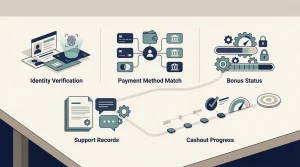


UKGC licensing is the starting point, followed by checks on regulatory records, promotions, verification and withdrawals.
Start with the licence, not the trust claims
A polished website, familiar payment options or confident claims about customer service do not establish that an online casino is authorised to serve people in Great Britain. Before weighing those claims, check whether the operator holds the relevant UK Gambling Commission licence. For real-money gambling offered to customers in Great Britain, that is the regulatory starting point, not an optional quality mark.
The rule applies whether the gambling business is based in Britain or elsewhere. An overseas address does not remove the licensing requirement when the operator offers gambling facilities to consumers in Great Britain. Equally, a site’s use of British pounds, English-language pages or a UK-facing brand is not proof that it has the required permission. Those features may make a service feel local; they do not replace a licence.
This distinction matters when you are trying to decide whether an online casino is trustworthy. Trust cannot be established by design, advertising or a list of games alone. A UKGC Licence indicates that the operator is within the Gambling Commission’s regulatory framework for the relevant market. Without that baseline, a casino’s own assurances are not a substitute for the oversight required for gambling offered to consumers in Great Britain.
Treat licensing as a threshold check rather than a final verdict. A licence does not mean that every feature, promotion or customer interaction will suit you, nor does it guarantee that you will have a trouble-free experience. It tells you that the operator is authorised within the British system. That is important evidence, but it is not a reason to stop asking sensible questions about how the service works.
Check the operator, not just the branding
A casino name and the company responsible for it may differ. When checking a UKGC Licence, make sure the public register connects the operator behind the site with the service you intend to use. Do not rely only on a badge or licence statement displayed on a casino page: confirm the licence number on the UK Gambling Commission’s public register before depositing.
No Account Casino UK: What the Label Really Means
This is a practical way to separate a verifiable claim from a marketing statement. If the details on the site do not lead you to a matching operator and licence record, pause rather than assuming the wording is accurate. A brand can sound established while leaving you uncertain about which business is responsible for the gambling service. The point of checking is to establish that the operator offering the facilities is covered, not simply that a company somewhere in a group has a regulatory connection.
The regulator’s remit is tied to where the gambling is offered, not merely to the operator’s headquarters. The Gambling Commission oversees remote gambling supplied to consumers in Great Britain. So, when a casino accepts customers there, the relevant question is not simply where the company is registered; it is whether it has the authorisation required for that market.
What the licence does—and does not—tell you
A valid licence gives you a firmer basis for assessing a casino than the word “trusted” on a homepage. It places the operator within a defined regulatory system rather than leaving its claims to stand alone. That makes licensing the first criterion to establish when comparing trustworthy casino sites for use in Great Britain.
It does not rank licensed casinos from safest to best, and it does not tell you that one is suitable for your circumstances. Several operators may meet the licensing threshold while differing in their services and terms. Nor does the existence of a licence erase the need to read what the casino says about its own arrangements. Keep the two questions separate: is the operator authorised to serve this market, and are the conditions of the particular service acceptable to you?
Be cautious with claims that turn licensing into a blanket promise. “Licensed” is meaningful only when it refers to the operator and gambling service you are considering, and it should not be presented as proof that every aspect of the experience is flawless. Conversely, a site’s appearance, popularity or positive testimonials cannot make up for the absence of the required authorisation.
If you are asking what makes an online casino trustworthy in Britain, begin with this regulatory check before comparing reputation claims. Confirm the UKGC Licence against the operator on the public register, and make sure the record relates to the service you are viewing. That will not answer every question about a casino, but it establishes the essential baseline: the business offering remote gambling to consumers in Great Britain must hold the relevant Gambling Commission licence, wherever it is based.
Attention: A UKGC Licence indicates that an operator is authorised within the British system, but it does not guarantee a trouble-free experience or that every feature will suit you.
Recommended online casinos
- x3betBonus: Welcome Pack 100% Up to £1.000 + 200 Free Spins · Payout speed: 1-3 business days
- NightWinBonus: £900 + 400 free spins · Payout speed: 1-3 business days
- WinBeastBonus: €5000 + 500 FS + €650 Freebet · Payout speed: 1-3 business days
- DieselwinBonus: Welcome Pack 250% up to £4000 + 200 FS · Payout speed: 1-3 business days
- ChanzeBonus: Slots Welcome Bonus #1 200% up to €500 · Payout speed: 1-3 business days
- Revery PlayBonus: 100% up to€1,000+ 100 FS · Payout speed: 1-3 business days
A licence is a starting point, not a clean bill of health
A current UKGC Licence tells you that an operator is authorised to serve customers in Great Britain. It does not, by itself, tell you how the business has handled every responsibility over time. If you are weighing claims that an online casino is trustworthy, its regulatory record can add useful context: not as a shortcut to a verdict, but as evidence of how the regulator has responded to specific conduct.
One concrete case concerns Grace Media (Gibraltar) Limited. On 26 June 2025, the UK Gambling Commission imposed a £60,000 financial penalty on the company for breaches involving self-exclusion and consent for direct electronic marketing. Those are not abstract administrative details. Self-exclusion concerns a customer’s ability to stop gambling through the relevant safeguards; marketing consent concerns whether direct electronic promotions are sent with the required permission. The penalty records regulatory action on both matters.
That information should be read precisely. It establishes that the Commission imposed a penalty for those breaches. It does not, on its own, establish what happened in every customer interaction, what any individual experienced, or whether the same problem is continuing today. Nor does a past regulatory action automatically tell you how a company has changed since then. It gives you a documented point to consider, rather than a complete account of the operator or a guarantee about future conduct.
Merkur Casino Online in the UK: What to Check
There is also a specific connection worth understanding before drawing conclusions about a casino brand. A public regulatory-register entry links 333casino.com to Grace Media (Gibraltar) Limited, under account number 57869, and identifies the domain as a White Label domain. This means the register associates that domain with the named account in that capacity. It gives you a reason to look beyond the brand name displayed to customers and identify the business connected with the domain.
But the link should not be stretched beyond what it says. A White Label entry is not proof that every decision affecting the site was made by one party, and the register detail alone does not explain the division of responsibilities between a brand and the company behind its account. Equally, the penalty imposed on Grace Media should not be described as a penalty imposed on 333 Casino unless the regulator’s record says that. The careful statement is that the register connects the domain with Grace Media, and that Grace Media was penalised for the specified breaches.
This distinction matters because casino names can be more visible than the legal entities associated with them. A reader may recognise a brand without knowing which company appears in a regulatory record. When you see a trust claim attached to a familiar name, check whether the claim refers to the brand, the operating company, or another business. Then compare those names with the relevant regulatory entry. A mismatch does not automatically prove wrongdoing; it means you need to understand what each name represents before treating the claim as meaningful.
Grace Media (Gibraltar) Limited was imposed a £60,000 financial penalty on 26 June 2025 for breaches involving self-exclusion and consent for direct electronic marketing.
Enforcement history is most useful when it is kept specific. Record the company named by the regulator, the date of the action, the kind of breach identified and the action taken. Here, those points are Grace Media (Gibraltar) Limited, 26 June 2025, breaches involving self-exclusion and direct electronic marketing consent, and a £60,000 financial penalty. Keeping the details together helps prevent two common errors: overlooking a relevant regulatory action, or repeating it in a way that makes it sound broader than the official finding.
A penalty can also be relevant even when your immediate concern is a different part of the customer experience. A casino’s public assurances may sound comprehensive, but a regulatory record gives you a separate, checkable account of what the regulator found in a particular case. That does not mean one past finding settles whether a casino is trustworthy today. It means a confident claim should be considered alongside evidence, not treated as evidence in itself.
For a trustworthy online casino UK assessment, the useful question is not simply whether a brand looks established or says it takes player welfare seriously. It is whether you can identify the responsible entity and understand any recorded regulatory action without confusing one company or domain for another. Grace Media’s penalty and the register’s link to 333casino.com illustrate why that distinction matters. They offer concrete context for assessing trust claims, while leaving room for the limits of what those records actually establish.
What “trustworthy” should mean when real money is involved
A trustworthy real-money casino is not defined by a polished website or reassuring language. What matters is whether the conditions of play protect you before money is at risk, and whether the controls remain usable once you have an account. Some safeguards are required under the rules for Great Britain; they are not optional signs of generosity from an operator.
Casino Without a Swedish Licence: UK Rules Explained
Age and identity checks must take place before you can deposit or play. If a site lets you fund an account first and promises to sort out verification later, that is not a harmless shortcut. The order matters: checks before access help prevent underage gambling and make it harder for someone to use another person’s details. You should expect the operator to establish who is opening the account before real-money play begins.
That does not mean every part of the process will feel effortless. A check may need information from you, and questions about identity or payment ownership can arise. The important safeguard is that the operator does not treat verification as something to postpone until after you have started gambling. Keep your account details accurate, and do not try to work around a request for information. If the account cannot be verified, depositing more will not solve the underlying problem.
Slot stakes are also capped according to age. If you are aged 18 to 24, the maximum stake is £2 per spin; from age 25, the maximum is £5 per spin. These limits apply to online slots, not every kind of casino game. They are designed to restrict the amount exposed on a single spin, but they do not make gambling risk-free: repeated play can still add up. Treat the cap as a boundary, not as a target or a guide to what you can afford.
Before your first deposit, you should also be prompted to set a financial limit. Account-level controls should remain accessible, so you can adjust your own boundaries rather than having to search through the site or negotiate with support. Choose a limit with your wider finances in mind, not just the balance you expect to have available on a particular day. A control is useful only if it is clear, easy to reach and applied as stated.
Do
- Complete identity and age checks before depositing
- Set a financial limit before your first deposit
- Reduce account limits to take effect immediately
Don’t
- Deposit money before completing verification
- Use slot stakes exceeding £2 (ages 18-24) or £5 (ages 25+)
- Assume an increase in limits will apply without a cooling-off delay
Pay attention to what happens when you change a limit. A reduction must take effect immediately; an increase is subject to a cooling-off delay. That difference is deliberate. When you decide to tighten a boundary, you should not have to wait for the change to protect you. By contrast, a pause before raising it gives you time to reconsider a decision made in the moment. If the site makes a reduction difficult to complete or suggests that it will not apply straight away, take that seriously.
These safeguards do not promise that you will win, prevent every poor decision or make a casino suitable for everyone. They set basic conditions around access and spending. Before you deposit, check that verification comes first, that the stake limits relevant to your age are respected, and that you can set and reduce account limits without friction. Those practical details matter more than confident claims about trust.
Trust also means control over promotions
A casino’s trustworthiness is not shown only by what it offers. It also matters whether you can decide which promotions reach you and how they are sent. Casinos must give customers more control over both the types of promotions they receive and the channels used to send them. That makes marketing settings worth checking before you accept an offer or leave notifications switched on.
Look for separate choices rather than a single all-or-nothing marketing preference. You should be able to consider whether you want promotional messages at all, which kinds of offers interest you, and which communication routes you are comfortable using. The precise options can differ between operators, but meaningful control means your preferences are not treated as one fixed bundle.
Safe Online Casinos in the UK: Licensing and Safety
Check the account settings for promotional preferences and read the wording carefully. A choice about the kind of promotion is not necessarily the same as a choice about how it arrives. If the settings distinguish between them, review each separately. For instance, you may want information about some offers but not want it delivered through every available channel. Use the controls to reflect that preference, rather than assuming one change covers all marketing.
It is also sensible to review these settings after registering, and again if you change your mind. An offer can make a particular promotion look appealing in the moment, but accepting it should not require you to welcome unrelated marketing. Before opting in, check what the selection applies to and whether you are agreeing to receive other promotional material as well. If the wording is unclear, pause and ask customer support to explain the available choices.
Pay attention to what happens after you update a preference. The settings should make it possible to see what you have selected and to change it later. If you cannot find the controls, or the options do not clearly distinguish promotion types from communication channels, ask the operator where those preferences can be managed. A clear answer is more useful than a general assurance that you can control marketing.
Promotional control is not the same as a promise that no operational messages will ever be sent. Keep the distinction in mind when reviewing a setting: it may concern marketing rather than information about your account. If you are uncertain what a particular option covers, get clarification before relying on it.
Promotional Control Check
- Review promotional preferences in account settings
- Distinguish between promotion types and communication channels
- Confirm if an offer requires opting into unrelated marketing
- Verify that you can easily revise your preferences later
The practical test is simple: can you make a choice that matches your preferences, understand what that choice covers, and revise it when needed? If not, you have less control over the experience than the rules intend customers to have. A casino that treats your marketing preferences seriously should provide clear choices, not make you hunt through unclear settings or guess which messages a selection affects.
This will not establish that a casino is trustworthy on its own. It is one concrete part of how the operator treats your choices. Promotions should remain something you can assess on their terms, not a reason to accept marketing you do not want. If an offer catches your attention, read its conditions separately from your communication settings; choosing whether to receive promotions and deciding whether an offer suits you are different decisions.
Read a register entry as evidence, not an endorsement
A register entry can answer a narrow but important question: which operator account is associated with a particular UK-facing domain? It cannot tell you whether the casino is the right choice for you, or whether every part of the experience will meet your expectations. Treat the record as evidence of regulatory status, not as a recommendation.
The UK Gambling Commission’s public register lists leovegas.co.uk as an active UK-facing domain linked to operator account 39198. The Commission’s operator record identifies LeoVegas Gaming PLC under that same account number. Reading the domain and operator records together helps establish that the named website is connected to a specific account held by a named company.
That connection matters when you are checking a casino’s claims. A familiar brand name alone does not show which legal entity operates a site, and a domain that looks plausible is not proof of authorisation. The register gives you a way to check whether the domain and operator account match, rather than relying only on what a website says about itself.
But an active domain entry has a defined limit. It does not certify that the casino is “trustworthy” in every practical sense, guarantee that a withdrawal will be handled smoothly, or show that a particular promotion is suitable for you. Nor does one record establish that every site using a related brand name is covered. The exact domain and the linked operator account are the details to compare.
Online casino payouts in the UK: RTP and returns
Register information can also change. If you are making a decision now, look at the live record rather than relying on a screenshot, an old article or a claim repeated on another site. Check the domain carefully, then confirm that the operator name and account number correspond. If a site gives you a different company or account detail, pause and resolve that mismatch before depositing.
This is a useful way to narrow a broad search for a dependable casino: move from a brand impression to a verifiable operator-domain link. It is not a shortcut to declaring one casino the best. The register establishes what it records; your judgement still needs to account for the terms, account controls and other details that affect your own use.
Check casino reviews against regulatory records
A casino review can be useful for collecting practical details, but its trust claims should not be the final word. Reviews may be out of date, may focus on bonuses and games, or may repeat an operator’s own description without checking it. Treat statements such as “fully trusted” or “no concerns” as claims to verify, not evidence in themselves.
The UK Gambling Commission’s public records provide a more direct way to check specific regulatory information. Compare an operator’s identity and any stated regulatory history with the Commission’s register and published enforcement decisions. Look for the legal entity behind the brand, the relevant date and the conduct described. A review that names its evidence and distinguishes a recorded fact from its own judgement is easier to assess than one that relies on broad assurances.
Grace Media offers a concrete example of the kind of detail worth checking. On 26 June 2025, the Commission announced a £60,000 penalty against the company. The action concerned failures related to self-exclusion and consent for direct electronic marketing. If a review discusses Grace Media or a brand connected with it, check whether it accurately describes that enforcement record and makes clear what the regulator found. A vague reference to “past issues” loses useful context; saying that a penalty proves every current practice is unsafe would go too far in the other direction.
Pay by Phone Mobile Casino Deposits in the UK
Read the review’s wording carefully. Does it separate an official regulatory finding from the reviewer’s opinion? Does it identify when the information was checked? Does it explain whether a claim concerns the operator, a particular brand or a specific domain? These distinctions matter: a brand name alone may not tell you which legal entity a regulatory record concerns.
Regulatory records do not answer every question about day-to-day service, and a positive review cannot erase an enforcement decision. Use each for what it can establish. A review can help you understand the experience it describes; the regulator’s own material is the stronger reference for formal actions and records. If the two disagree, pause before relying on the review’s reassurance and establish which claim is supported by the primary record.
Make verification and withdrawal checks before you deposit
A trustworthy online casino should make its identity-check requirements clear before you fund an account. Under UK rules, you must be verified before you can deposit or play, so treat a promise to “sort the paperwork later” as a reason to pause rather than an invitation to get started.
The documents commonly requested are a photo of your passport or driving licence and a recent utility bill. The identity document helps confirm who you are; the bill can support a check of your address. Before uploading anything, read the casino’s instructions carefully: the image needs to be clear, the details legible and the documents consistent with the information you gave when registering. If something is unclear, ask what will be accepted before sending files.
Also check how documents are submitted and how the casino explains their handling. Use the account’s stated upload route, rather than sending sensitive images through an unexpected message or link. If the account name, address or other details do not match your documents, contact the operator before making a deposit. A mismatch can create avoidable questions when you later request a withdrawal.
A first withdrawal may involve another review of your documents, even if you have already supplied them. One specialist review reports that first-time cash-outs can face an extra 12–24 hours for document checks. Treat that as a reported estimate, not a guaranteed timetable: processing can depend on whether the casino needs clearer images or further information. Check the operator’s own withdrawal terms and leave room for a review before relying on the money arriving by a particular time.
Verification Process
Step 1: Document Preparation
Prepare a clear photo of your passport or driving licence and a recent utility bill.
Step 2: Submission
Upload the documents through the casino’s stated account route, ensuring details match your registration.
Step 3: Withdrawal Review
Allow for a potential extra 12–24 hour review period during your first cash-out for document verification.
Before you deposit, look for a plain explanation of which documents may be requested, how to provide them and what could delay a first cash-out. Keep copies of what you submit and any confirmation that the casino has received it. If a request arrives after you have asked to withdraw, compare it with the operator’s published instructions and contact support through the account if you are unsure. Clear requirements do not guarantee a smooth withdrawal, but they let you understand what is expected before your money is involved.
Why “non-GAMSTOP” needs particular caution
“Non-GAMSTOP” can sound like a simple preference for fewer restrictions. In Great Britain, however, it is also a warning to pause and check what the operator is offering. Online operators within the UK Gambling Commission’s regime have been required to take part in GAMSTOP since 31 March 2020. A casino presented as an option for people in England, Scotland or Wales to avoid that scheme does not fit the safeguards expected of a UKGC-licensed service.
That matters especially if you have registered with GAMSTOP to block your access to gambling. Seeking another site that claims to operate outside the scheme may undermine the boundary you chose to set. If the urge to find a way around self-exclusion feels difficult to manage, consider contacting the National Gambling Helpline on 0808 8020 133, which is available around the clock. There is no need to wait until a situation feels like a crisis to ask for support.
The jurisdictional detail is important. The Gambling Commission’s remit under the Gambling Act 2005 covers Great Britain; Northern Ireland is not within its remote-gambling remit. That does not mean a casino outside the UKGC system is therefore a trustworthy choice for someone in Northern Ireland, or that the same rules apply across the UK. It means the British licensing and GAMSTOP requirements should not be described as if they govern Northern Ireland in the same way.
Treat claims about a “non-GAMSTOP casino” as a reason to establish which jurisdiction the operator serves and whether it is presenting itself as available to customers in Great Britain. The label alone cannot establish a lawful basis to serve those customers, nor can it establish that a site is safe. An offshore operator may be accessible, but accessibility is not evidence of UKGC oversight.
If you are checking a service for use in Great Britain, do not treat an absence from GAMSTOP as a benefit that can outweigh the licensing question. Participation is part of the regime for UKGC-regulated online operators, not an optional badge. If you have self-excluded, the safer course is to respect that protection rather than look for a route around it.
Bitcoin and Ethereum casinos: apply the same licensing test
A casino’s use of Bitcoin or Ethereum does not replace the legal test for serving players in Great Britain. If a remote gambling business offers facilities to consumers in England, Scotland or Wales, it needs the relevant UK Gambling Commission licence, wherever the business itself is based. The currency mentioned in a promotion or on a payment page does not change that requirement.
This matters because a reference to cryptocurrency can draw attention away from the more basic question: is the operator authorised to offer remote gambling to people in Great Britain? Treat a Bitcoin or Ethereum label as a description to investigate, not evidence of a licence. Likewise, a site’s wording does not establish that it accepts either currency. Check what the operator actually states, and assess its UK status separately.
Best offshore casino sites: how UK rules apply
Separate the payment claim from the licence claim
A casino may use language about Bitcoin, Ethereum or digital currency in different ways. It might be describing a payment option, referring to a wider product, or using the terms to attract attention. The wording alone does not tell you which applies. Do not assume that a casino accepts a particular currency simply because it appears in a headline, search result or promotional description.
Even where a payment option is clearly described, that is a separate point from whether the business may legally provide gambling to consumers in Great Britain. A payment page cannot establish that an operator holds a UKGC Licence. Nor does a claim about a licence establish that Bitcoin or Ethereum is available as a payment method. Keep those questions distinct rather than allowing an answer to one to stand in for the other.
The same approach applies if a casino calls itself a crypto casino or promotes a product for Bitcoin users. Those labels are not a substitute for checking the operator’s authorisation. If you cannot establish that the business holds the relevant UK Gambling Commission licence for offering remote gambling to Great Britain, do not treat its cryptocurrency claims as a reason to proceed.
Do not let the currency distract from who is offering the gambling
The relevant licence attaches to the business offering gambling, not to a coin or a wallet. When reviewing a site, identify the operator responsible for the gambling service and assess whether it is licensed to offer that service in Great Britain. A company’s location does not create an exception: the licensing requirement applies regardless of where the remote gambling business is based.
This is a useful distinction when a site’s branding, payment information and company details are presented in different places. A brand name may not make clear which business operates the casino. Before relying on any statement about Bitcoin or Ethereum, establish which operator is behind the gambling offer and whether that operator meets the Great Britain licensing requirement. If the information leaves you unable to identify the operator or verify its status, the payment wording has not resolved the uncertainty.
A licensed status is not proof that every claim on a site is accurate, and the presence of a cryptocurrency reference does not tell you whether the business is licensed. They are different pieces of information. Avoid treating a polished presentation or a detailed description of digital currency as evidence of regulatory authorisation.
Apply one standard to both currencies
Whether you are considering a casino described as accepting Bitcoin or one described as accepting Ethereum, use the same sequence of checks. First, establish that the business is offering remote gambling to consumers in Great Britain. Then identify the operator and confirm that it holds the relevant UK Gambling Commission licence. Only after separating those questions should you consider whether the operator’s own information clearly explains the payment method it offers.
Do not read a cryptocurrency label as a guarantee of availability, suitability or regulatory standing. A site might mention one currency without offering it for gambling, and a payment claim cannot by itself show that the operator has permission to serve British customers. Equally, the licensing test does not depend on whether a customer intends to use traditional money or a digital currency.
This standard avoids giving Bitcoin and Ethereum casinos a different set of rules simply because the payment language is unfamiliar. The key point remains the same: remote gambling offered to consumers in Great Britain requires the relevant UK Gambling Commission licence, regardless of the operator’s location. If that requirement is not met, a cryptocurrency feature does not make the offer acceptable under the Great Britain regime.
Material created by the team SlotMonster